Can one rationally choose a career?
I write this for my many young friends who are either passing out of school or high school or graduating from university, and who are a little troubled by the big decision of their lives. Ah! Yes, deciding our career is a big deal. And yes, there are many hurdles in the path as well as many naysayers and misguides. So how do we objectively take a decision.
Do we decide on the basis of what our elders say? If so, then do our elders know what is right? Do they know the new trends and courses and challenges? And even if so, is what they think right, right for us?
So do we then decide on the basis of the money prospects? Do we choose the "hot" career? What if the trend changes? What if the money is just a hype? What if the "hot" career turns out to be a "hot" seat?
Hmm! Then we must go by what our marks say! But then which marks to choose - school or entrance tests? Can the entrance test we take once or twice decidedly know who or what we are? Can the school know for sure what we are? Are the marks of a written exam sufficient to know my psyche? Can the scholastic subjects like Math and History decide what kind of thinker I am? Can they tell me where I will be successful?
SO, should I not go for success? But then I want to be successful so that I can earn money and that in turn would make me happy. SO should I rather aim for happiness???
Whew!!!
Lot of thoughts ... lot of questions. We have all been through this, those of us who crossed this stage in our lives. I ask them - Are you happy? What parameter did you use to take the decision - Money, Marks, Possibility of Success, Popularity of the career or simply Joy? And I know that most of you who have succeeded and some of you who have not, when we cross our mid-life and our strengths start to dwindle, have realized that .... It Matters Not Whether We Won Or Lost ... But Only How We Played The Game.
But then of course WE the "elders" want the best for our young ones. And so the young persons out there must not ignore the advice of their elders, as neither should they cling on to their elders. So can there be a way in which all the stakeholders - the person concerned, his/her parents, teachers and other relatives (Well they do have a huge role to play in the Indian scene) - take a decision together without conflicts and without bias and reach to a workable plan?
I propose a plan here that has worked for me and for thousands of my students at Abhinav and some through the Philosophy Olympiads.
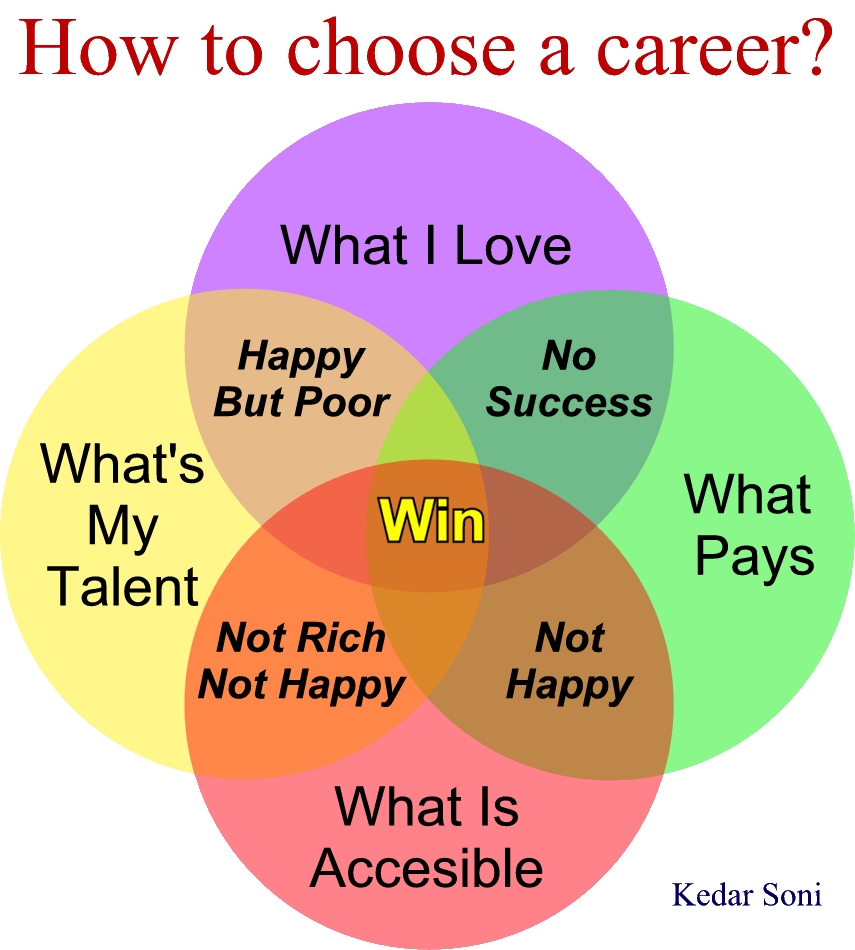
Step 1. What do I love?
If you do that which you do not love, simply because it is a paying career or because its available or "someone says so", you will never be happy. To find out what do you love ask yourself the following:
- What subjects or activities at school / college do I like doing?
- Which activities out of school / college do I enjoy the most? Even playing or interacting with friends is important.
- What is it that I can enjoy doing for long periods of time?
Hence, shortlist a few activities / interests. This may include reading, chatting with friends, solving puzzles, studying and thinking about history, discovering places on maps, etc. These activities need not be known careers like medicine, engineering and so on. Each career has certain traits which are necessary in the person. The activities you choose here will show you those traits.
Now give marks to the activities on a scale of 10. The one's you love doing most get higher marks.
Step 2. What's my talent?
If you do not have the ability to do that which you like, you will never succeed. So next step is to discover your talents. These may or may not include the above activities. You may be good at math, but not like it. Never mind, include it in the list. When thinking of your talents do not be biased by what you like doing or what is a "hot" career, etc. Simply focus on these few questions.
- In which subjects at school / college do i score highest? Am I better than most of the class in these, if not then maybe they are not really a talent. e.g. my highest marks are in English, say 50%, while the class highest is at 70%, then English cannot be my talent.
- In which activities outside of school, or those in school but not associated with academics, do I excel? e.g. I may be good at dance or running. Again, if I haven't won any awards in these, then it may not be my talent.
- If I haven't sparkled in front of the world by doing things that win awards, YET ... Are there things that I do in my free time, which are productive, like - teaching other kids, making handicraft items, helping dad with his shop or mom in the kitchen, or simply thinking about how other people think and usually be right in predicting their actions.
A more systematic way of finding out about your talents (however not the most accurate) is to take certain online tests. (free for a basic result and paid for detailed analyses) Some of these tests may not work on you if you are too young like say in std VIII or so. The tests may also not work because you may misunderstand the question or you did not think hard enough. These tests will however, help diagnose if you are seriously talented in a particular area.
- Personality types and career indicators - such as the MBTI or the Jung Typology Test.
- Intelligence - Simple IQ tests, Weschler Scale (for 6-16 yrs), Multiple Intelligence
Step 3. Discover and connect careers to activities?
Here is where the elders come in in an important way. Young people know whet they like and what they think they are good at. Elders can help refine these thoughts. However, what careers demand such personalities, is something only an elder who has been through that stage can know.
For example if someone likes to interact with people a lot, is very shrewd in choosing which people to make friends with and can convincingly argue on certain topics, however, is not good at any school subjects, could make a good career in marketing. Someone who is very quiet and reserved and like to think a lot about the world around and is only interested in talking with adults (that too the wise and educated) at length on different topics, can find a good path as a writer or philosopher. If a young person enjoys working with his hands and accepts / understands the science in the "books" only after he performs the experiments himself, would work well in a practical industry like manufacturing.
So what needs to be done is as follows:
- Find out about different careers online. There is a wealth of information available. e.g. Collegegrad gives a listing and hence details of almost a 1000 careers and you could choose the ones you like to read about. Also, if you cant think of the career which matches your likes and talents, then you could do a keyword search on the career database. These sites give you a fair idea of the job descriptions, the courses you need to do and to some extent the salary you can expect.
- Choose the top 5 interests and talents from your previous listing. For these items ask your parents or other elders in the family to help you guess which careers can your list of activities match-up with.
- Find someone in your friends and family who is already into that career and try talking to them about what are efforts involved or how satisfied they are and whether your personality is appropriate for this work. If nothing, you could always find someone on the internet who is famously into that career and write to them.
Step 4. What pays?
If you choose a path which wont even pay for your basic necessities, you wont survive for long, leave alone being happy. So with the information from the websites and other elders around you, ask these questions:
- How much money do I need to survive today, if I were living on my own?
- How much salary / money should I earn to take care of a family living in this part of the world as of today? Would I be willing to live alone my whole life if my career doesn't pay enough?
- How much do my top 5 careers pay?
- If my favorite career doesn't pay enough, can I do something on the side to make enough money and yet retain my main interest?
- Can I do my favorite "career" as a hobby and take up a more paying career? Will I be able to devote time to my favorite job?
- Sometimes some careers are more paying for a few years and then the trend changes. Are my favorite careers just trends (so I must be cautious) or are they "stable and paying" for last many decades?
Step 5. What is accessible?
One may find a career for which he is passionate and has talent and it is also will pay him well; however the courses / learning needed may not be easily available. You may want to become a pilot and there may be no course in any nearby college which trains you to be so. You may not want to take a long-cut like do a regular graduation and then try going to a far-away place for this course. You may want to be a doctor, but you got a few marks less than required to get admissions due to the cut-throat competition or the course fees are exorbitant. So think about the following:
- What courses would you need to do to realize your career? Sometimes you may not need a course but rather a particular kind of person (a Guru if you will) to teach you the ropes of the career like an apprentice.
- Are such courses / people available at a convenient place?
- Are such courses / people affordable?
- Is the time required to finish these courses not a problem for you? e.g. If you need to earn in a hurry as your dad is retiring, then a 7 year PhD may not be right.
- Are you capable of putting the efforts that the course demands? e.g. Engineering demands 8 hrs of lectures and almost the same for practical / study work per day. Can you handle that?
Now rank the top few courses in your list on a scale of 10 using this last criteria.
And ... here's your decision. Try for the top career in your list. If that fails for some reason, move down the list.
Some caution
The road to taking these big decisions of life is never easy. It may take you many days or months to decide after doing the above process, and the decision you take may change after a few years as your circumstances change. And yet the process I have outlined above is the surest way to take a good decision. After doing the steps diligently, you may still not get the best out of life or be the happiest, but you will surely have no regrets. An informed decision is usually the right one. So all the best ...


